
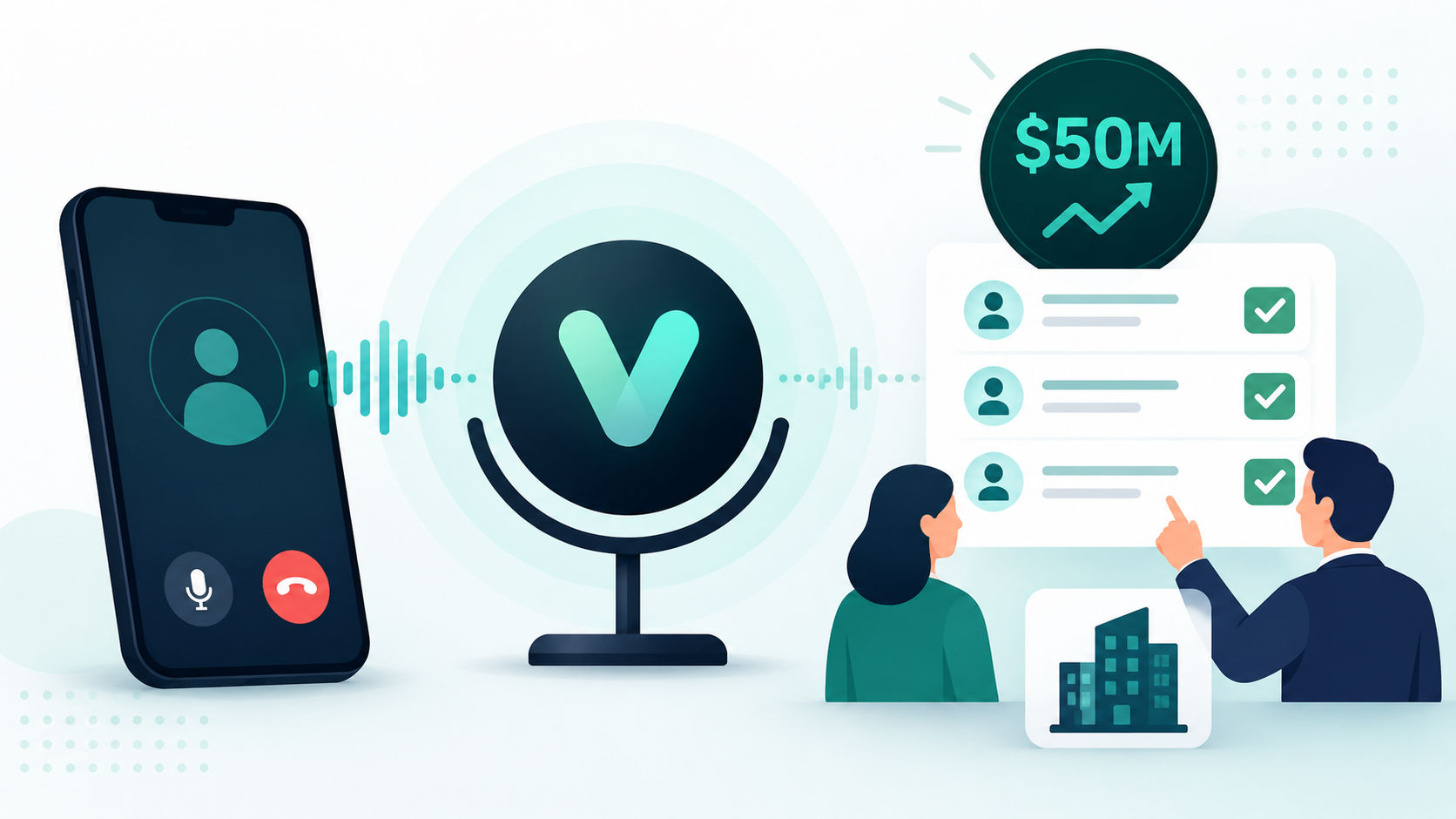
Vapi's $50 million Series B shows voice AI moving from demo-friendly call automation into production revenue infrastructure. For B2B lead generation and SaaS sales teams, the question is no longer whether an AI agent can sound natural. The question is whether it can qualify intent, capture the right context, respect consent rules, escalate safely, and leave behind a call record that buyers and operators can trust.
Vapi announced on May 12, 2026 that it raised $50 million in a Series B led by Peak XV, with participation from M12, Kleiner Perkins, Bessemer Venture Partners, YC, and earlier investors. The company said the round brought total funding to $72 million and followed 10x enterprise ARR growth, more than 1 million developers, over 2.7 million unique agents created, and more than 1 billion calls made on the platform.
Those numbers make the story look like another AI infrastructure funding milestone. The more useful read for revenue teams is narrower: the phone is becoming programmable again.
Voice is still where high-intent commercial moments happen. Buyers call after a webinar, a search result, a referral, a pricing question, a support issue, or a renewal concern. If AI starts handling those calls at scale, it becomes part of the sales system, not a contact-center side project.
What Vapi Is Selling
Vapi describes its product as an enterprise voice AI platform for building, deploying, and managing configurable voice agents. Its announcement names use cases including inbound customer service, outbound collections, candidate screening, sales coaching, autonomous IVR navigation, and high-volume qualification workflows.
That range matters because voice AI is not one workflow. A support agent, lead-qualification agent, collections agent, scheduling agent, and outbound prospecting agent all carry different risks.
The platform promise is that companies can build for those workflows without assembling telephony, speech recognition, language models, text-to-speech, routing, latency management, call logging, and human escalation on their own.
That promise also raises the standard. A voice agent sits in a live conversation. When it misunderstands the buyer, overpromises, stalls, or fails to escalate, the company loses trust in real time.
Why It Matters For B2B Lead Generation
Most AI sales experiments have been text-first: outbound email, LinkedIn messaging, content drafts, account research, enrichment, chatbots, and call summaries. Voice has been harder because it has less tolerance for latency, ambiguity, and cleanup.
That is why Vapi's funding round is relevant to B2B lead generation. If voice AI becomes reliable enough for production, the phone can become a scalable intent-capture channel again.
Take a common SaaS scenario. A prospect finds a vendor from search, reads a comparison page, and calls to ask whether the product integrates with Salesforce, HubSpot, Snowflake, or a security stack. A human team may miss the call or fail to log the context. A strong AI voice agent could capture the problem, qualify urgency, answer approved fit questions, schedule a next step, and push structured notes into the CRM.
That is not just call deflection. It is pipeline capture.
The same pattern can apply to event leads, demo confirmations, product-led usage signals, partner referrals, renewal warnings, and expansion accounts. The agent does not need to replace sales. It needs to prevent commercial intent from dying because no one was available at the right moment.
The Trust Problem Moves To The Call
The hard part is buyer trust. The phrase "AI voice agent" may create curiosity, but it also creates immediate objections.
Did the caller know they were speaking with AI? Was the call recorded? Was consent captured? Did the agent make a claim about pricing, contract terms, eligibility, security, implementation timing, or support coverage? Did it log the conversation accurately? Did it escalate when the buyer moved outside the approved path? Could the company audit the interaction if the buyer later disputes what was said?
Those questions are especially sharp for outbound use. The FCC's February 2024 declaratory ruling confirmed that TCPA restrictions on artificial or prerecorded voice calls encompass current AI technologies that generate human voices. Details depend on call type, number type, jurisdiction, consent basis, and exemptions, so this is not legal advice. It is a practical warning: outbound AI voice should not be treated like a weekend growth hack.
Inbound workflows carry different risks, but they still need governance. A lead qualification agent should not invent pricing. A support agent should not promise refund terms. A sales agent should not create contract exceptions. A scheduling agent should not collect sensitive data without a clear purpose.
Revenue leaders should ask one plain question before launch: what is the agent allowed to decide, and what must a human approve?
Enterprise Voice AI Needs Monitoring
Vapi's own materials point to the operational standard that buyers will expect. In a company blog post, CEO Jordan Dearsley wrote that enterprises cannot put agents in front of millions of customers without "compliance, observability, hard guardrails, predictable latency under load, and clean escalation to humans." The funding announcement also says Vapi sees the next phase of voice AI being defined by governance and predictability.
That is the right frame. Serious voice AI should be evaluated as production infrastructure.
Production infrastructure needs monitoring at the call level. Did the call connect? Was latency acceptable? Did the agent understand the request? Did the transcript match the conversation? Was the outcome correct? Did the buyer get routed to the right team? Did the CRM receive usable fields? Was a human brought in when confidence dropped or policy required escalation?
These are not back-office details. They affect conversion.
If an AI voice agent misunderstands a prospect and triggers the wrong follow-up, the vendor has damaged the opportunity before a seller enters the conversation. If it creates more meetings but lower-quality pipeline, the efficiency gain may hide a win-rate problem. If it fails to capture consent or opt-out context where required, the growth motion may create risk faster than revenue.
Customer Experience Is The Commercial Hook
Vapi's announcement also ties into a broader customer experience problem. Qualtrics XM Institute estimated that nearly $3 trillion of global sales are at risk in 2026 because of poor experiences. That is a vendor research estimate, but it captures a real executive concern: bad interactions have measurable revenue consequences.
Voice is one of the places where those consequences show up quickly. People call because the issue matters enough to interrupt their day. They want resolution, not another channel to manage.
For B2B SaaS companies, the same principle applies even when call volume is lower than in consumer support. A buyer who calls after category research may be signaling urgency. A customer who calls before renewal may be exposing the expansion blocker. A partner with a referral may be handing over intent that should not land in voicemail.
Voice AI can improve those moments only when it makes the interaction easier, not more evasive.
What Revenue Teams Should Evaluate
The first evaluation point is call type. Is the agent handling inbound lead capture, outbound qualification, appointment setting, support triage, collections, renewal risk, or sales coaching? Each use case has a different risk profile and a different definition of success.
The second point is allowed scope. The agent should have a clear boundary around what it can answer, what it can collect, which systems it can update, what claims it can make, and when it must hand off.
The third point is handoff quality. The CRM record should not be a raw transcript dump. It should show why the call mattered: account, contact, source, need, urgency, qualification status, objections, consent status where relevant, meeting outcome, next step, and owner.
The fourth point is measurement. Compare AI-handled calls with human-handled calls on qualification accuracy, meeting conversion, no-show rate, escalation rate, complaint rate, compliance exceptions, and downstream opportunity quality. A tool that increases booked meetings while reducing opportunity quality is not improving lead generation.
The fifth point is buyer disclosure. Teams should decide how the agent identifies itself, what recording notice is required, how callers can reach a human, and what language is approved for sensitive claims.
The Operator Takeaway
Vapi's raise does not prove every company should automate sales calls. It does show that voice AI has reached a level of investor and enterprise attention that revenue teams should evaluate carefully.
The useful standard is controlled conversion. A voice agent should capture intent faster, reduce missed opportunities, improve buyer experience, and create clean sales context while staying inside consent, disclosure, data, escalation, and logging rules.
That is the real B2B lead generation angle. The winners will not be the teams that deploy AI voices fastest. They will be the teams that make voice workflows trustworthy enough to put real buyers on the line.
Sources
- Vapi funding announcement: https://www.globenewswire.com/news-release/2026/05/12/3292882/0/en/vapi-raises-50m-series-b-as-it-reaches-1-billion-calls-powering-the-next-generation-of-enterprise-voice-ai.html
- Vapi CEO blog: https://vapi.ai/blog/series-b
- TechCrunch: https://techcrunch.com/2026/05/12/vapi-hits-500m-valuation-as-amazon-ring-chose-its-ai-platform-over-40-rivals/
- Axios Pro preview: https://www.axios.com/pro/enterprise-software-deals/2026/05/12/voice-ai-vapi-enterprise-agents
- Qualtrics XM Institute: https://www.qualtrics.com/articles/customer-experience/3-trillion-risk-due-bad-customer-experiences-2026/
- FCC declaratory ruling: https://docs.fcc.gov/public/attachments/FCC-24-17A1_Rcd.pdf