
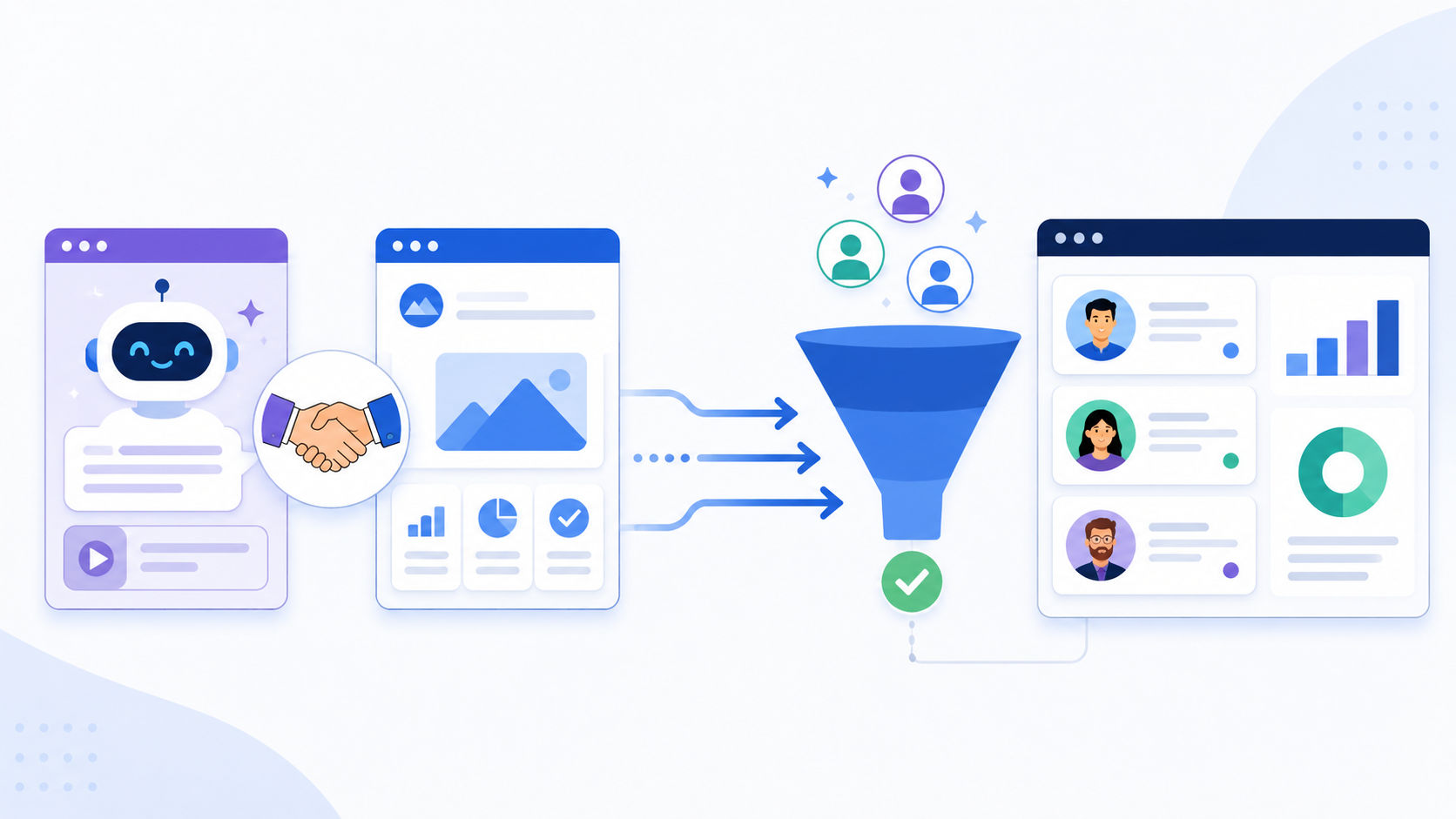
Consensus' planned acquisition of Peel shows that AI demo automation is moving into B2B lead generation infrastructure. If buyers can ask product questions, explore use cases, and reveal intent before a rep enters the process, revenue teams need a stricter way to qualify self-guided engagement and decide when sales should intervene.
On April 22, 2026, Consensus announced that it entered into a definitive agreement to acquire Peel, an AI platform that turns static content into real-time conversations between buyers and agents. Consensus said the transaction is expected to close in Q2 2026, subject to customary closing conditions and approvals. Financial terms were not disclosed in the reviewed announcement.
The company framed the deal around an AI-powered conversational demo platform. That matters because demo automation has typically been treated as sales enablement or product marketing: a buyer watches a product tour, clicks through a guided path, or receives a recorded walkthrough. Peel moves that experience closer to a two-way buying interaction.
For SaaS founders, demand generation leaders, and revenue operations teams, the practical question is not whether AI can make demos feel more interactive. It is whether demo engagement can become a reliable source of pipeline intelligence without creating another layer of noisy intent data.
The Demo Is Becoming a Qualification Surface
Most B2B lead generation programs still separate content engagement from sales qualification. A prospect visits a page, downloads an asset, registers for a webinar, or fills out a demo form. Marketing scores the activity. Sales decides whether the account is worth pursuing.
Interactive demos blur that sequence.
Consensus says the combined platform will turn websites, videos, presentations, PDFs, and other assets into adaptive buyer experiences. It also says those interactions can capture zero-party intent and inform next best actions. In plain terms, a buyer's questions inside the demo become part of the qualification record.
That can be useful. A buyer who asks about enterprise SSO, healthcare compliance, Salesforce integration, procurement timing, or migration from a named competitor is not behaving like someone who casually watches a two-minute overview video. The signal is more specific and closer to a real buying task.
But the signal is only valuable if the revenue team defines it carefully.
Not every conversation is intent. Some visitors are researching casually. Some are students, competitors, consultants, job candidates, or low-fit users. Some questions may come from curiosity rather than budget. If every AI demo interaction becomes a hot lead, sales teams inherit a different version of the same old MQL problem.
The better operating move is to treat conversational demo data as evidence, not proof. It can improve prioritization, but it should be combined with account fit, source quality, buying-stage context, and human review when the deal is complex.
Buyer-Led Does Not Mean Rep-Free Forever
The timing of the Consensus-Peel announcement fits a broader shift in B2B buying behavior. Gartner reported on March 9, 2026 that 67% of B2B buyers prefer a rep-free experience and 45% used AI during a recent purchase. Buyers want more control before they speak with sales.
But rep-free does not mean rep-useless.
On May 20, 2026, Gartner reported that 69% of B2B buyers prefer to validate AI-generated insights with sales reps. Buyers also reported using an average of seven information sources during a recent purchase. That is the important nuance for teams evaluating AI demo tools.
Buyers may not want to wait for a scheduled discovery call to understand a product. They may not want a generic demo that repeats what they already read. They may want to explore on their own, build an internal shortlist, and test assumptions before giving a vendor calendar time.
Still, when the purchase becomes material, buyers often need validation. They need to know whether the product claim is accurate, whether the implementation path is realistic, whether the security answer will satisfy internal review, and whether pricing or packaging actually maps to their use case.
AI demo automation should not be designed as a replacement for sales. It should be designed as a better filter for sales. The product experience should answer common questions, surface real concerns, and give the seller a clearer reason to enter the conversation.
The Trust Risk Is Accuracy
The commercial upside is clear: fewer wasted demos, faster education, richer intent data, and more buyer-friendly paths to product understanding.
The trust risk is just as clear. If an AI demo agent gives the wrong answer, overstates a feature, mishandles security language, invents an integration, or creates a misleading implementation expectation, the vendor may create a sales problem before a seller ever joins the account.
That is especially dangerous in high-consideration SaaS categories. Cybersecurity, compliance, finance, healthcare, HR, data infrastructure, and revenue operations tools are not bought only on feature interest. They are bought through risk review. A buyer may like the product experience and still need proof that the claims are controlled.
This is where revenue operations, product marketing, legal, and security need a role in AI demo governance. The content corpus behind the agent should be current. Product limitations should be clear. Claims should be traceable. Regulated or security-sensitive answers should avoid improvisation. The handoff to sales should include the questions asked, the assets used, and any uncertainty that requires follow-up.
That may sound operationally heavy, but it is the price of using AI in a buyer-facing role. A static product tour can be wrong, but its wrongness is usually bounded. A conversational product experience can create more surface area for mistakes.
Demand Generation Needs Better Measures
For demand generation teams, the Consensus-Peel deal points toward a better measurement model than raw form fills or content downloads.
The old question was, "Did this asset convert?"
The better question is, "Did this experience help a qualified buying group understand value, expose a real problem, and move toward a useful next step?"
That shift changes the metrics. Teams should look at whether target accounts are engaging with relevant product paths, whether multiple stakeholders from the same account are exploring connected topics, whether questions map to active buying concerns, and whether sales conversations start with better context.
It also changes the content strategy. If AI demo experiences are built from weak, generic assets, they will produce weak, generic conversations. Product marketing needs modular proof points, role-specific narratives, integration details, implementation guidance, security answers, customer evidence, and competitive positioning that can be reused safely by both buyers and sellers.
The goal is not to automate persuasion. The goal is to make the buyer's independent research more useful and make the seller's eventual involvement more precise.
What SaaS Teams Should Do Next
Revenue teams evaluating AI demo automation should start with four practical rules.
First, define which demo behaviors indicate serious buying intent. A pricing question, integration question, compliance question, and migration question should not carry the same weight as a generic feature click.
Second, map the handoff. Sales should know what the buyer explored, what questions they asked, what claims they saw, and what needs validation. Without that context, AI demo data becomes another dashboard instead of a better conversation.
Third, control the source material. Buyer-facing AI should draw from approved, current, and auditable content. If the agent cannot answer safely, it should route the buyer to a human or a controlled resource.
Fourth, watch for false confidence. A smooth conversational demo can make a product feel easier to buy than it is to implement. That gap becomes churn risk if sales and customer success do not reset expectations.
Consensus' planned Peel acquisition is worth watching because it moves demo automation closer to the center of the revenue engine. The teams that benefit will not be the ones that simply add an AI layer to every asset. They will be the ones that treat buyer-led product exploration as a trust-sensitive lead generation channel, with clear qualification rules and a disciplined handoff to sales.
Sources
- Consensus announces definitive agreement to acquire Peel
- Consensus: Why We Acquired Peel
- Gartner: 67% of B2B buyers prefer a rep-free experience
- Gartner: 69% of B2B buyers turn to sales reps to validate AI-generated insights