
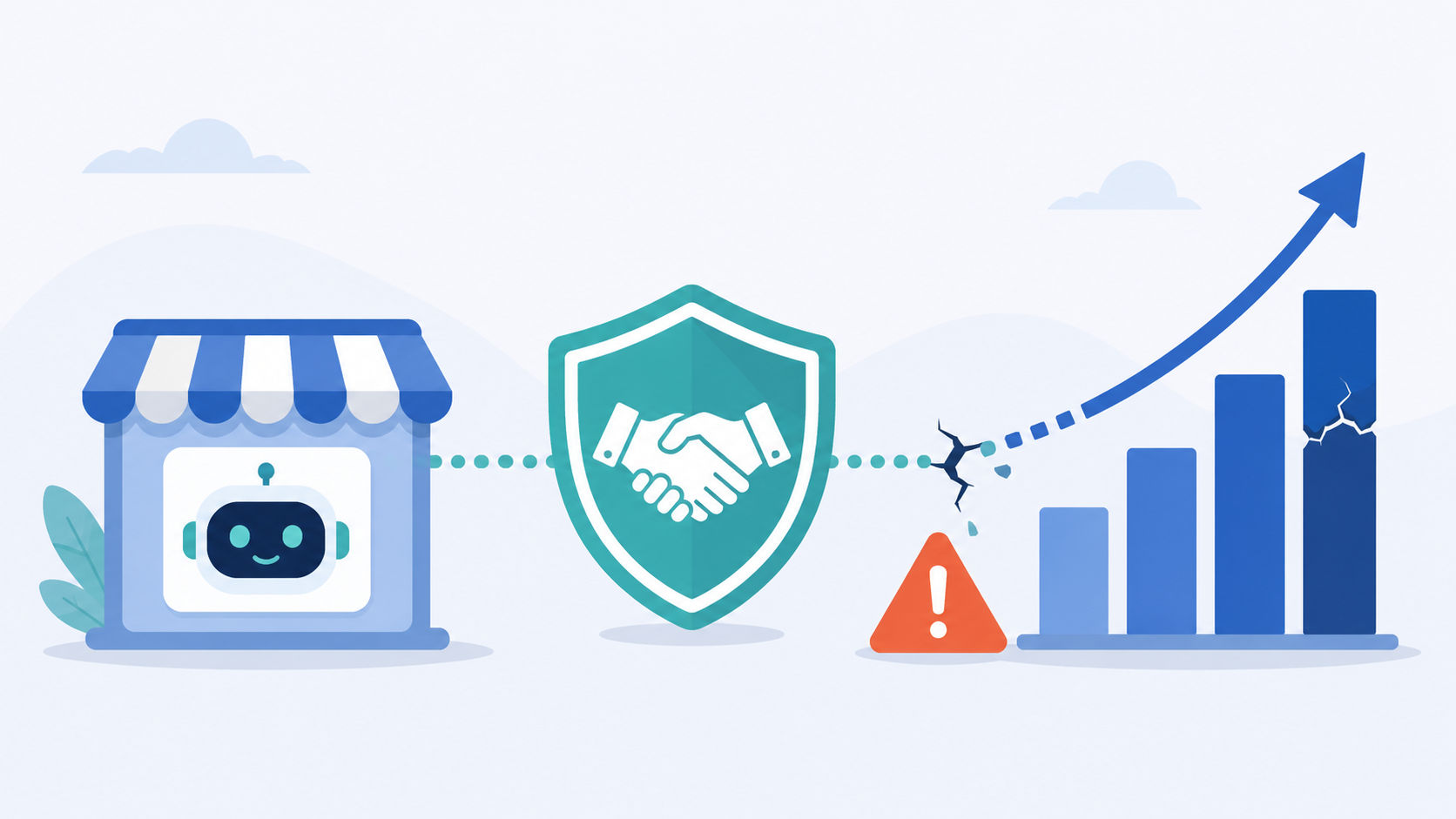
The Braintrust incident is not only a security story. It is a sales story.
When an AI vendor tells customers to rotate sensitive API keys, the urgent work belongs to security, engineering, and operations teams. Credentials have to be revoked. Provider usage has to be checked. Logs need review. Stakeholders need a quick answer to a simple question: what was exposed?
But the second-order effect lands somewhere else.
It lands in pipeline.
Every security incident involving AI infrastructure gives buyers another reason to slow down, ask harder questions, and demand proof before they share data with a vendor. That matters for cybersecurity companies, AI platforms, sales-intelligence tools, enrichment providers, lead-generation vendors, and any SaaS company using AI as part of its growth story.
The news peg
TechCrunch reported on May 6, 2026 that AI evaluation startup Braintrust urged customers to revoke and replace API keys after unauthorized access to one of its AWS cloud accounts. The account contained customer API keys used to access cloud-based AI models.
SecurityWeek reported on May 8 that Braintrust discovered the incident on May 4 after suspicious behavior was reported, communicated with customers on May 5, and included indicators of compromise and remediation steps. Braintrust also locked down the compromised account, restricted related systems, rotated internal secrets, and continued investigating.
The public reporting matters because this was not a generic data-exposure story. It involved credentials that could connect downstream systems.
TechCrunch reported that Braintrust had not found evidence of broader exposure at the time of disclosure. SecurityWeek reported that at least one customer was affected and that three others had reported suspicious spikes in AI-provider usage. Those details may evolve as investigations continue. The broader lesson is already visible.
AI middleware can become a credential warehouse.
Why revenue teams should care
The obvious response is to file this under security operations. Rotate keys. Review logs. Tighten controls. Move on.
That is necessary, but too narrow.
For SaaS companies, vendor trust now affects the path from lead to closed deal. Buyers are asking more security questions earlier in the journey. Procurement teams are pulling risk reviews forward. Legal teams are asking how vendors handle customer data, model access, prompts, logs, and third-party subprocessors. Security teams want to know whether an AI feature is only a workflow improvement or a new data path.
That pressure is measurable. Sophos-backed research published in 2026 found that only 5% of surveyed organizations fully trust their cybersecurity vendors. The same research found that 79% struggle to assess the trustworthiness of new cybersecurity partners, while 62% struggle to assess existing ones.
That is a demand-generation problem.
If buyers cannot tell whether a vendor is mature, transparent, or prepared for incidents, the vendor pays in longer sales cycles, weaker conversion, lower demo-to-close rates, and more late-stage procurement friction. Security trust becomes part of positioning.
AI makes the trust question sharper
AI tools complicate vendor evaluation because they often sit near sensitive workflows.
A sales team might use AI to enrich accounts, summarize calls, personalize outbound, score leads, classify intent, or generate follow-up copy. A product team might use AI evaluation tools to test prompts, log model behavior, compare providers, or monitor production output. A support team might use AI to draft replies or search customer history.
Each use case sounds operationally small. Together, they create a map of sensitive context: customer names, account signals, usage patterns, internal notes, prompt history, API keys, model outputs, and sometimes regulated data.
That does not mean companies should avoid AI vendors. It means AI vendors have to be evaluated like infrastructure providers, not lightweight productivity tools.
The buyer question is changing from "Does this tool make us faster?" to "What new dependency does this tool create?"
What this changes for lead generation
Lead generation teams often treat trust as a brand attribute. The website has a security page. The vendor has a trust center. The SDR can say SOC 2 if asked.
That is no longer enough for security-aware buyers.
The first conversion may still come from a pain point, but the next conversion increasingly depends on proof. If a company is using AI for enrichment, outbound personalization, lead scoring, demo preparation, or customer research, buyers will want to know what data is used, how it is stored, whether model providers receive it, and what happens when a downstream supplier has an incident.
That changes content strategy, too. A useful SaaS growth program should not only publish product benefits and customer stories. It should publish answers to the trust questions that block deals.
For example:
- What customer data does the product need, and what does it not need?
- Are credentials stored, and if so, how are they scoped and rotated?
- Which third-party AI providers process data?
- Can customers disable AI features or limit data retention?
- What incident-notification commitments exist?
- What evidence can procurement review before the contract stage?
These are not only compliance details. They are conversion assets.
The new buyer expectation: show the evidence early
The Sophos research points to a larger market shift. Buyers want verifiable artifacts, not broad assurances. That is especially important in AI, where the product claim often depends on data access, automation, and third-party model providers.
Vendor trust has often been handled as late-stage documentation. A prospect likes the product, asks for security review, receives a questionnaire, and then the process slows down. That model is inefficient in a market where buyers are already overloaded with AI claims.
The stronger approach is to surface trust earlier:
- Put the trust center where prospects can find it.
- Explain AI data flows in plain language.
- Maintain a current subprocessor list.
- Describe incident response without hiding behind vague policy language.
- Give sales teams a concise security narrative they can use without improvising.
- Build lead magnets around buyer-risk education, not only feature comparisons.
This is not about turning marketers into CISOs. It is about making sure marketing does not create demand that security cannot defend.
A practical checklist
The Braintrust incident should not produce panic. It should produce a checklist.
For any AI-enabled growth or SaaS vendor, answer four questions before buyers ask them:
- What sensitive data, credentials, or customer context does the product touch?
- Which third-party systems can access that data?
- What evidence proves those systems are governed, monitored, and limited?
- What will customers hear from the company in the first 24 hours of an incident?
The companies that can answer clearly will move faster through procurement. The companies that cannot will keep discovering that trust is not a slogan. It is a sales-cycle variable.
Sources
- TechCrunch: AI evaluation startup Braintrust confirms breach, tells every customer to rotate sensitive keys
- SecurityWeek: AI Firm Braintrust Prompts API Key Rotation After Data Breach
- Braintrust: Trust Center updates
- Sophos: Only 5% of organizations have full trust in their cybersecurity vendors
- OWASP: Top 10 for LLM Applications v2025